| status | active (presumed) |
| location | interior, bubble layer [n] |
| population | classified |
| language | geometric script (tick-differentiated) |
| known words | mo, plulux, and others |
| food supply | do not inquire |
| cosmology | bubble-layered; contested |
| ruling body | none formally established; Singer presides |
| current Singer | Yuki |
The settlement referred to in this entry exists within a semi-permeable atmospheric boundary of uncertain origin, known informally as the bubble. The bubble is simultaneously a physical boundary, a meteorological phenomenon, and — according to some theological traditions within the settlement — a living entity. Its name, if it has one, has not been recovered.
The city is compact. Buildings are arranged in close proximity along clean, narrow streets. Residential units follow a vertical logic: apartments are small, markets are near, umbrella racks are positioned at regular intervals throughout the settlement. Schools are disproportionately large relative to their student populations.[1]
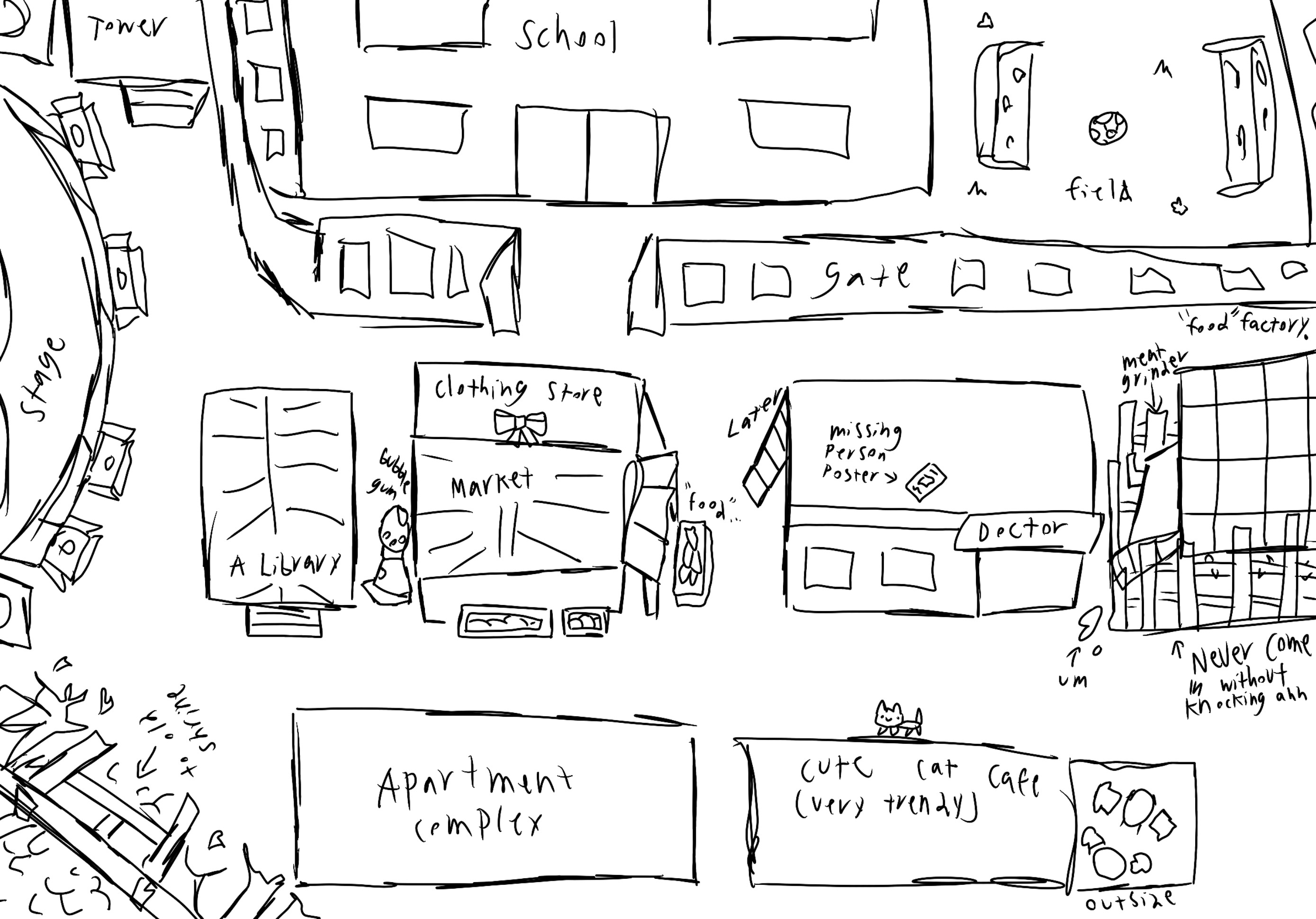
The settlement's spatial organization places the Tower and Stage adjacent at the western edge, with the School occupying the northern center and a field to its east. A Gate runs across the middle of the settlement. The Library, Market, Clothing Store, and Bubblegum Machine form a commercial cluster in the central district. The Doctor's office and the food processing facility occupy the eastern edge. The Apartment Complex and Cute Cat Cafe anchor the southern end. The path to the Old Shrine runs southwest.
The settlement uses a geometric writing system of uncertain age. Letters are differentiated by tick-marks applied to base shapes, producing a counting-like logic: similar forms carry related but distinct meanings, distinguished in speech by tonal variation. The script contains no letter Z.
The following is a partial record of known words and phrases. It is understood to be incomplete.
plulux — rain; the color blue; the reflective quality of light on wet surfaces; considered fortunate.
riiea — to sing.
riieaii — singing (active form).
lumiinu — light.
vuldenai — dark (as condition or quality).
vulden — dark (as color or clothing; adjectival).
umaiu — cute.
flurdeliis — pretty.
fumiumikuminumi — funny; hilarious.
funi — cat. funi-funi — a group of cats.
kara — dog.
wako — shrimp. wako-wako — a group of shrimp.
daana — affectionate term for a close friend.
mashivue — goodbye; see you later.
The following phrases and idioms have also been recorded. Their precise origins are, in most cases, unclear.
liwurnas — literally: you are a dirty sock that needs cleaning. Used to indicate that a person is a mess, or is behaving like one.
funikara — literally: that cat looks like a dog. Used when something is not what it appears to be. (kara = dog.)
kono-mu-naur — literally: I ran to school but a cat jumped in front of me, so I got a bad grade. Used to describe any inconvenience that derailed an otherwise good plan. The cat need not be literal.
nailaune — did you see the black hoods? Used as both a question and an expression of unease; sometimes invoked when something feels wrong without explanation.
Scholars note that the script's geometric character suggests either a founding culture with strong mathematical traditions, or an origin in direct observation of the settlement's mineral environment. Both theories remain active. The absence of Z is conventionally attributed to theological reasons. The tension between the language's mathematical foundations and the expressiveness of words like riieaii and plulux has been noted but not resolved.
Rain in the settlement is frequent and unpredictable. Residents regard it as a sign of good fortune and are well-prepared: umbrella racks are distributed throughout the city as standard civic infrastructure. The rain is known as plulux, a word that also encompasses the color blue and the quality of reflected light. In certain conditions, the chemical composition of the bubble causes rainfall to carry an unusually vivid blue luminescence.
Theological and meteorological scholarship within the settlement has not formally connected rainfall to the degradation of outer bubble layers, as this information is not in general circulation. Residents associate rain primarily with civic celebration, specifically the performance of the Singer.
Current cosmological models hold that the settlement exists within one of several nested bubble layers. Outer layers, when degraded, produce rainfall. Whether the bubble itself constitutes a boundary, a being, or both remains a matter of active theological dispute.
.png)
The following sequence has been recently reconstructed from available accounts. It represents, to the best of current scholarly knowledge, what occurs when the bubble degrades sufficiently to permit angel incursion. It has occurred at least once within living memory.
- 01Ordinary commerce is underway. A transaction at the food processing facility is interrupted when a customer departs without paying.
- 02The bubble bursts. Observed from below: a rupture in the sky, visible from street level.
- 03Angels enter the settlement. The community, having no framework for the arrival of angels — whose names exist only in writing and have never been spoken aloud — treats the event as a disaster. Most residents seek shelter indoors or beneath awnings. The response is confused rather than organized.
- 04At least one resident does not reach shelter in time.
- 05The operator of the food processing facility is occupied with the unpaid transaction and is slow to respond to the wider situation.
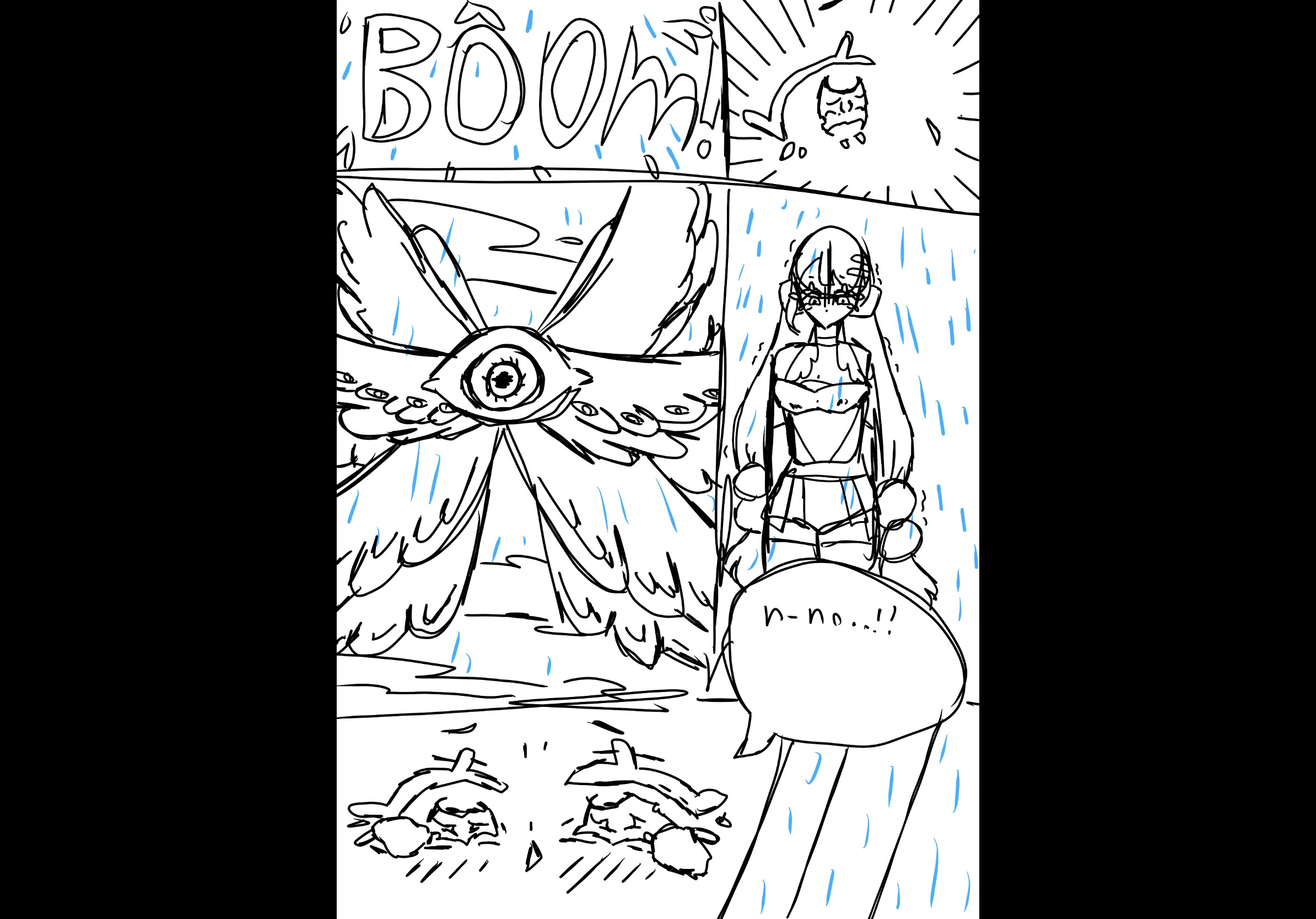
- 06The Singer — walking home from school, unaccompanied — observes the rupture and the angels. Her expression has been described as horror informed by knowledge: not surprise, but recognition.
- 07The Singer proceeds to the stage without changing clothes. She begins to sing.
- 08Residents observing from windows and doorways call out to her. She continues.
- 09One or two residents leave shelter and move toward the stage.
- 10Angels move through the settlement's streets. At least one resident encounters them directly.
- 11The song destroys the angels. The bubble is revived.
- 12The settlement enters a period of aftermath. See below.
The bubble event produced a number of consequences that restructured the settlement in significant ways.
During the commotion, the operator of the food processing facility made remarks in a public setting regarding the nature and sourcing of the settlement's food supply. These remarks were heard by multiple residents. Information previously held by a small number of people — teachers, sanitation workers, shop owners, the Singer, and others — entered general circulation for the first time.
Community response to this information was not uniform. Some residents expressed retroactive grief for individuals who had passed through the facility. Others raised practical concerns about the continuity of the food supply. A small number attempted to minimize or contextualize what had been disclosed. The operator of the facility was driven out of the settlement. The facility was abandoned.
The facility's robot — previously employed in operations at the food processing facility — remained in the settlement after its creator's departure. Without a defined purpose, the robot began moving through the settlement's institutions: assisting at the Cat Cafe, working alongside the doctor, taking on tasks at the library. It was, by most accounts, considerably better liked than its creator. Its relationship to its own origins remained unresolved.
Questions generated by the bubble event and its aftermath that remain open in surviving records include: how does a song destroy an angel; what replaces the food supply; what becomes of the abandoned facility; what became of the operator outside the settlement's walls; and whether the robot constitutes a new kind of resident or a continuation of something else.
The current Singer is known as Yuki. She maintains two distinct presences: a civilian form, in which she moves through the settlement largely unremarked upon, and a performance form, in which she appears before the public following rainfall. The two forms are visually discontinuous enough that residents do not consistently connect them.
In civilian form, Yuki is a student at the settlement's school. She is vegetarian. She is aware of the full cosmological situation, including the function of the tower and the nature of the food supply. This knowledge is not widely known. She is described by those who know her well as deeply insecure and constitutionally generous — a person who gives without expecting acknowledgment, and who would not easily claim credit for what she sustains.
Her private ritual: she visits the shrine and says, quietly, something approximating a thank you — to the bubble, to her own abilities, to past Singers. It is not performative. It takes approximately as long as a breath.
In performance form, Yuki presents in the palette associated with the shrine — pink, aqua, and the blue of plulux — such that she visually blends into the shrine environment when she visits it. She has merchandise. Attendance at her concerts is high. A subset of attendees wear her merchandise as a mark of devotion.[2]
.png)
The tower is adjacent to the stage at the western edge of the settlement. It serves multiple functions, not all of which are publicly documented. The settlement's doctor resides in the tower. The tower is also the location to which students are eventually brought to receive certain information regarding their role in the settlement's maintenance.
A missing person poster has been observed on the roof of the doctor's office. It was placed there intentionally. By whom, and for whom, is not recorded in this volume. A sign on the building reads: never come by without knocking.
The doctor is understood by the general population as a pleasant and courteous figure. They are aware of considerably more than they discuss.
Entities referred to in surviving texts as angels are understood to be non-linguistic beings of significant physical capability. They do not name one another. They do not appear to engage in self-conception. Their names, where recorded, exist only in written form and are never spoken aloud.
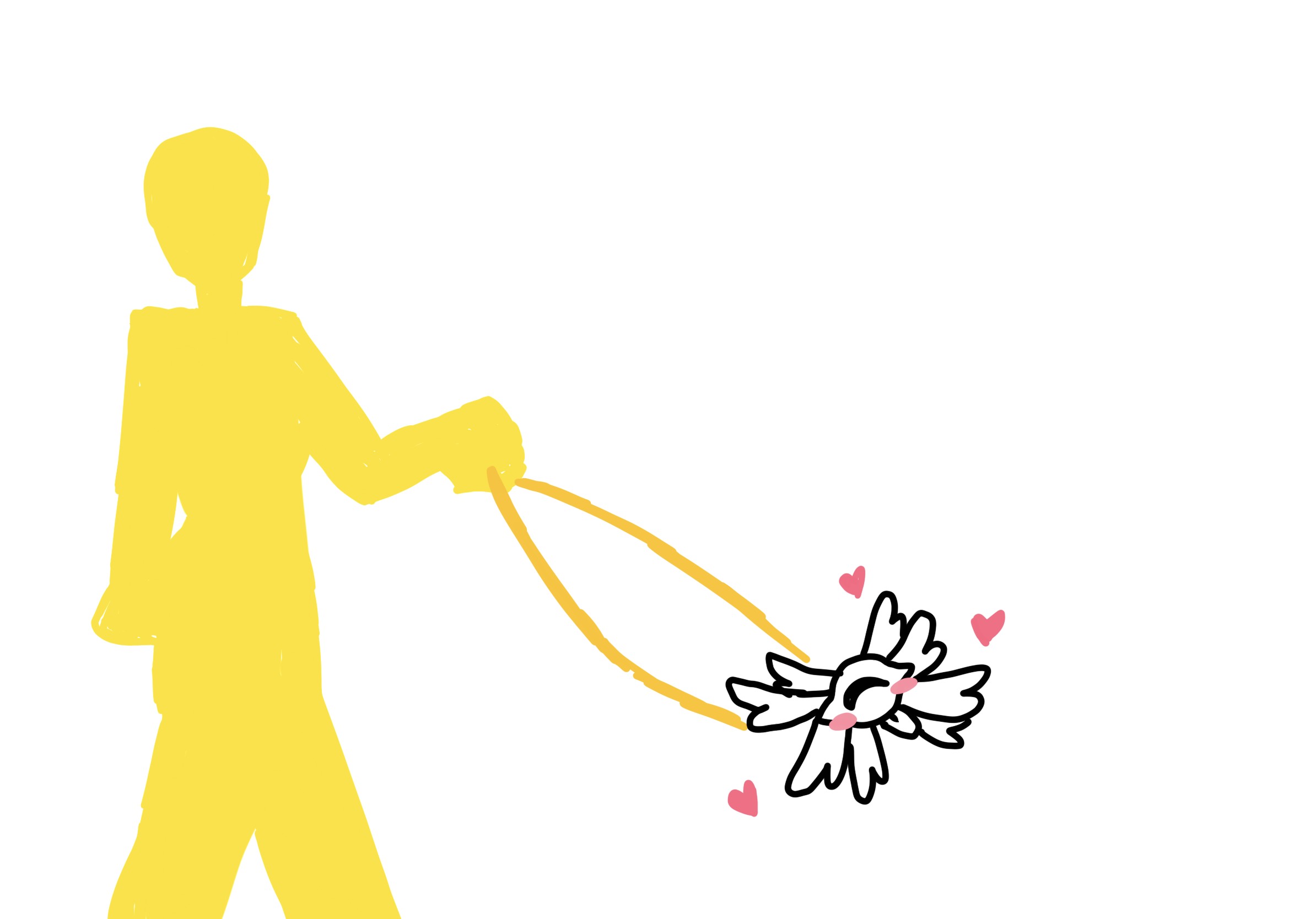
Their relationship to the bubble's degradation is a matter of ongoing scholarly discussion. Their relationship to the Singer is similarly complex. A popular image in folk iconography depicts a large luminous entity walking a smaller one on a leash; the smaller entity appears content.
Angels are believed to move through bubble layers over time, making progress at rates that vary by generation. In generations where a Singer is absent or weakened, angels advance more rapidly. In generations of strong Singers, their progress slows or reverses.[3]
During the bubble event described above, angels were observed moving through the settlement's streets. They were destroyed by the Singer's performance. Whether this constitutes a permanent resolution or a temporary one is not addressed in available documentation.
A small number of young residents have been documented exhibiting anomalous capabilities in relation to the angels. These individuals, referred to colloquially as the magical girls, are distinguished by transformative experiences linked to contact with angels — including documented cases of physiological change, most notably alteration of eye color.
Their precise relationship to the Singer, to the bubble's maintenance, and to the angels is the subject of ongoing investigation. It is not known whether they are extensions of the Singer's power, candidates for future succession, or something else entirely.
One documented individual was noted to have two yellow eyes prior to a significant encounter, and one yellow and one white eye thereafter. No official explanation has been provided.
The seven known students at the settlement's school are understood to be among this group. Their responses to information about their situation vary by individual. At least one is connected by family to the food processing sector.
The settlement's school operates with a full staff despite a student population of approximately seven. Teachers are drawn from a limited pool of residents on a rotating basis functionally analogous to jury duty: selected individuals are conscripted at irregular intervals and are expected to arrive prepared. The curriculum covers standard secondary subjects. There is no formal explanation for why the school building is as large as it is.
Teachers are, as a class, vegetarian. This is not framed as protest. It is understood among those who know the relevant facts as a logical response to those facts. Teachers are among the small number of residents who are fully informed about the settlement's cosmological situation. Because the pool from which teachers are drawn is limited, the majority of the settlement's population remains unaware of the full picture.
The tower, adjacent to the school, is the location where students are eventually brought to receive certain information. What they do with that information varies.
The facility referred to in this entry as the food processing facility was, until recently, the settlement's primary source of food. Its operators dressed in all-black robes and practical footwear. They were not typically seen. When they were seen, people tended not to comment.
The facility's lead operator maintained a household staffed by a small number of individuals, including at least one head maid whose relationship to her employer was built on demonstrated competence rather than affection. Whether the maid valued the position for its safety, its consistency, or the absence of better options remains unclear. She was, by all accounts, exceptionally capable. Her eyes — whether because of their remarkable quality or because of what they concealed — drew attention.
The facility's robot was constructed by the lead operator and assisted in facility operations. Following the operator's expulsion from the settlement, the robot remained. It has since been observed in multiple roles across the settlement's institutions. It is not known whether the robot understands what it was built to do, or what it has chosen to do instead.
The facility itself stands abandoned. Its future use is undetermined.
The Apartment Complex is the primary residential building for most of the settlement's population. Units are small. The building faces the Cat Cafe to the south and the stage to the west. Residents on upper floors use stairs.
.jpeg)
.png)
The Cute Cat Cafe is described in available records as very trendy. It is popular with students and functions as a homework spot and informal gathering place. The origin of the cat cafe — who established it, how it received authorization — is not documented. A cat is typically visible on the roof.
The Library houses two librarians whose approaches are complementary rather than competing: one is quiet, precise, and holds information the other does not; the other is loud, approachable, and holds information the first does not. The library is preferred over the Cat Cafe for serious study. It has been noted by some residents that the louder librarian does not quite seem like herself, though no one has articulated why.[4]
The Bubblegum Machine sits between the library and the market. It is smaller than it looks on maps. It functions as a landmark. Its name, informally, is Bubblegum.
The Clothing Store has no windows. It is well-lit from 6am to 6pm and dim outside those hours. It closes between 9 and 10pm.
The Old Shrine is accessible via a path to the southwest. Flying cicadas have been recorded in the surrounding area. The shrine shares its color palette with Yuki's performance form. Whether this is coincidence, influence, or design is not addressed in public documentation.
Several persistent rumors have circulated among students at the settlement's school across multiple generations. Their origins are unknown. Their accuracy varies. They are reproduced here without editorial comment.
It is said that if you go to the Old Shrine at 1am, the shrine disappears, leaving only a void. Some students believe this explains why there are only seven students in the school. Others are skeptical but prefer not to test it.
It is said that there is a black hole in the forest near the shrine. It selectively takes students with bad grades. Students with good grades are, by most accounts, unconcerned. Students with bad grades tend to avoid the forest.
The older generation recalls a rumor that the school used to have more students, but that many fell through trap doors in the floor and were never seen again. No trap doors have been officially documented. The school has not commented.
A more recent rumor holds that everyone in the settlement is a skinwalker. Most students dismiss this. At least one student has spent a day looking at everyone — including the cat at the Cat Cafe and the doctor — with pointed suspicion. There may be a grain of truth in the rumor. The precise size of that grain is not addressed in this volume.
It has also been suggested, by those familiar with the food processing facility, that at least one entity associated with that facility was capable of absorbing and replicating the identity of another person. Whether this entity is still present in the settlement, and in whose form, is a matter of ongoing concern.
The settlement is quiet in the early morning. A bird call or two has been recorded at intervals. Footsteps on the cement sidewalks produce a muted clicking sound.
By mid-morning the ambient sound increases: market vendors, students moving toward school, ordinary conversation. Flying cicadas can be heard from the direction of the shrine path as the day progresses, increasing toward late afternoon. Birds favor the tower.
The food processing facility produces a low hum audible from the street. From inside, louder. Workers passing through the area would have had to raise their voices to be heard.
When it rains, the settlement's mood shifts. Umbrellas appear. People move toward the stage. The sound of plulux on cement has not been formally described in surviving texts, but is understood to be the sound of good fortune arriving.
The Singer's voice, when she performs, carries across the settlement. It has been described as changing the quality of the air. Residents who have heard it from indoors report that it reaches them even through closed windows.